SOLID Principles in Software Development - 5 DIP
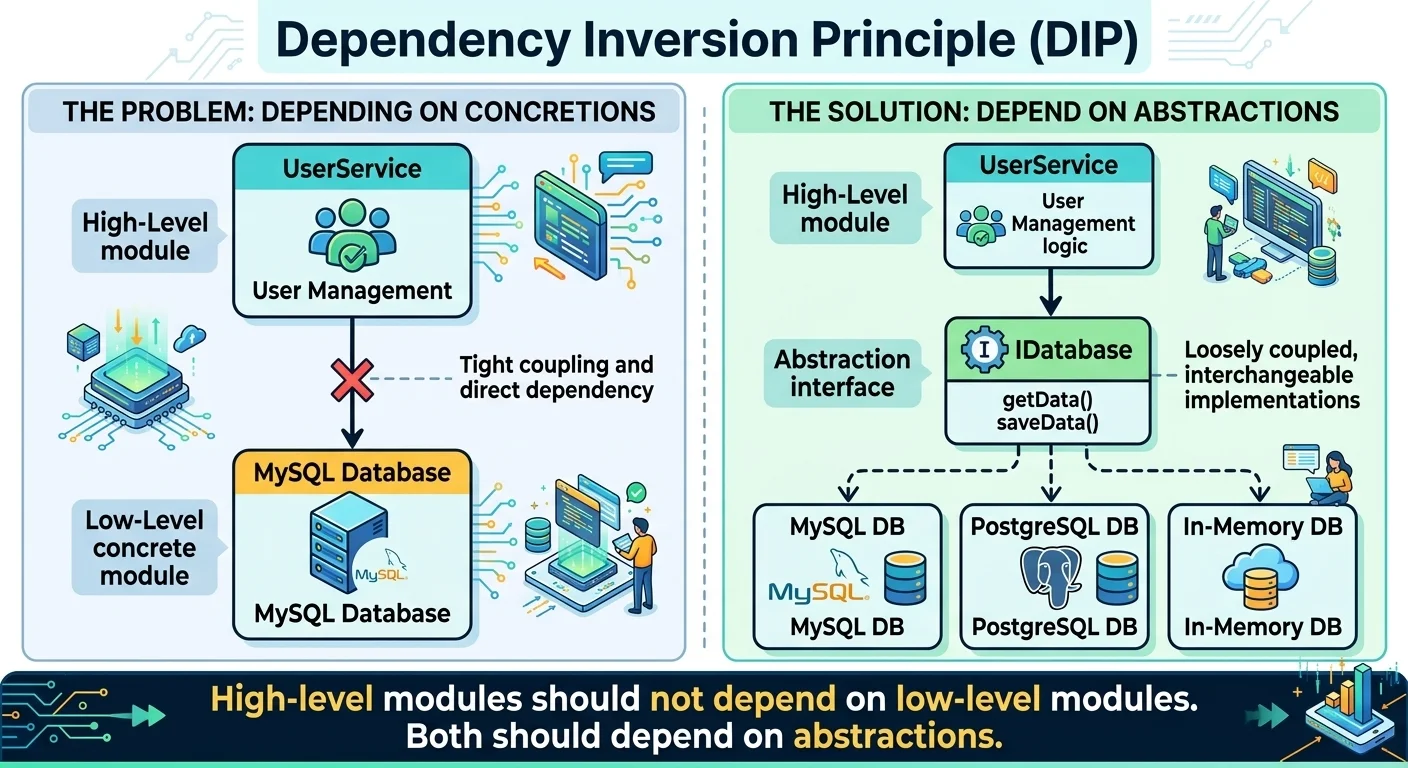
The Dependency Inversion Principle (DIP) is the fifth and final SOLID principle, and it ties everything together. It states: high-level modules should not depend on low-level modules; both should depend on abstractions. Also: abstractions should not depend on details; details should depend on abstractions. In practice, this means your business logic shouldn’t know about your database, your HTTP client, or your file system — it should only know about interfaces. The concrete implementations get injected at runtime.
The problem appears when high-level code directly imports and instantiates low-level details. Imagine a UserService that creates a MySQLDatabase connection in its constructor. If you want to switch to PostgreSQL, or test with an in-memory store, you have to modify UserService itself. That’s a violation of DIP — and also of OCP, since you’re modifying existing code to change behavior.
The problem: depending on concretions
class MySQLDatabase:
    def connect(self):
        return "Connected to MySQL"

    def query(self, sql):
        return f"MySQL result for: {sql}"

class UserService:
    def __init__(self):
        self.db = MySQLDatabase()  # Hardcoded dependency!

    def get_user(self, user_id):
        self.db.connect()
        return self.db.query(f"SELECT * FROM users WHERE id = {user_id}")
Here, UserService (high-level business logic) depends directly on MySQLDatabase (low-level detail). Want to test without a real DB? Can’t. Want to use PostgreSQL in staging? Modify the class. This coupling makes the system rigid and hard to evolve.
Applying DIP: invert the dependency
We introduce an abstraction (IDatabase) and inject it:
from abc import ABC, abstractmethod

class IDatabase(ABC):
    @abstractmethod
    def connect(self):
        pass

    @abstractmethod
    def query(self, sql):
        pass

class MySQLDatabase(IDatabase):
    def connect(self):
        return "Connected to MySQL"

    def query(self, sql):
        return f"MySQL result for: {sql}"

class PostgreSQLDatabase(IDatabase):
    def connect(self):
        return "Connected to PostgreSQL"

    def query(self, sql):
        return f"PostgreSQL result for: {sql}"

class InMemoryDatabase(IDatabase):
    def __init__(self):
        self.data = {}

    def connect(self):
        return "In-memory ready"

    def query(self, sql):
        return f"Mock result for: {sql}"

class UserService:
    def __init__(self, database: IDatabase):
        self.db = database  # Dependency injected!

    def get_user(self, user_id):
        self.db.connect()
        return self.db.query(f"SELECT * FROM users WHERE id = {user_id}")
Now UserService depends on IDatabase (abstraction), not on any concrete implementation. You can swap databases without touching UserService — just pass a different implementation at construction time.
Real-world example: Flask app with environment-based wiring
from flask import Flask, jsonify
import os

app = Flask(__name__)

# Factory: choose implementation based on env
def create_database() -> IDatabase:
    db_type = os.getenv("DB_TYPE", "memory")
    if db_type == "mysql":
        return MySQLDatabase()
    elif db_type == "postgres":
        return PostgreSQLDatabase()
    else:
        return InMemoryDatabase()

# Wire up once at startup
db = create_database()
user_service = UserService(db)

@app.route("/users/<int:user_id>")
def get_user(user_id):
    result = user_service.get_user(user_id)
    return jsonify({"user": result})

if __name__ == "__main__":
    app.run(debug=True)
Set DB_TYPE=postgres in production, DB_TYPE=memory in tests. Zero code changes in UserService.
The Dependency Inversion Principle is the glue that makes the other four principles practical. SRP gives you focused classes. OCP lets you extend them. LSP ensures substitutions work. ISP keeps interfaces minimal. DIP wires it all together without creating a tangled mess of concrete dependencies.
When you apply all five, you don’t just get “clean code” — you get a system where:
- Business logic is testable in isolation
- Infrastructure swaps (DB, API, queue) are one-line changes
- New features don’t require rewriting old ones
- The architecture reflects the domain, not the framework
SOLID isn’t a checklist you tick off once. It’s a mindset you practice every time you draw a line between “what” and “how”. And when you do, your code stops being a liability and starts being an asset.
o/

Marco
Romero
Hi! I am a software developer with a solid development background and experience in various technical areas. I complement my technical skills with studies in teaching, which has enhanced my ability to communicate complex concepts clearly and effectively, as well as to collaborate in dynamic environments.
I have a proven track record in problem solving and incident management, applying a methodical and results-oriented approach. I quickly adapt to new technologies and methodologies, keeping up with industry trends to deliver innovative and efficient solutions.
- Name
- Phone
- Web
- Home
- Marco Antonio Romero Torrez
- +54 280 484 2576
- marcoromero.dev@gmail.com
- marcoromero.com.ar
- Puerto Madryn, Chubut - Argentina